
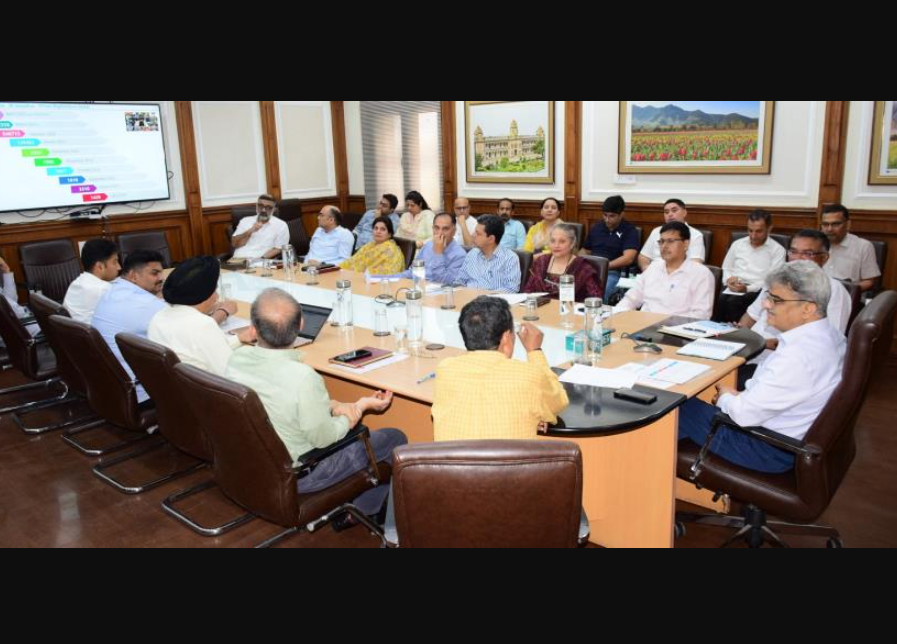
During a comprehensive review meeting led by Chief Secretary Atal Dulloo, the performance of the JK Samadhan 2.0 public grievance redressal system came under scrutiny, with a particular focus on how promptly, effectively, and with what quality government departments and district administrations were responding.
The Secretary of the Public Grievances Department joined Administrative Secretaries from various departments at the meeting, while Deputy Commissioners from across the Union Territory participated virtually.
The Chief Secretary emphasized that a successful grievance redressal system is defined not just by the number of complaints registered, but by how well and how quickly those complaints are resolved to the satisfaction of the citizens. He stressed that addressing citizens’ issues in a timely manner is crucial for building public trust in the governance system and encouraging their ongoing engagement with administrative platforms.
Dulloo pointed out that simply acknowledging grievances isn’t enough to build citizens’ confidence. People will only feel motivated to bring their issues to the administration’s attention when their concerns are addressed promptly and effectively.
He described public grievances as a valuable tool for understanding the health of governance at the grassroots level. According to him, a thorough analysis of these grievances can act as a map, highlighting recurring problems within specific departments or geographical areas. He urged departments and district officials to use the platform not only for resolving grievances but also as a way to strengthen institutional responsiveness and improve public service delivery on the ground.
The Chief Secretary placed special emphasis on the quality of resolutions, advocating for grievance redressal that truly satisfies the concerned citizen. He directed that no grievance should remain unresolved for more than 30 days. Furthermore, he instructed all departments and Deputy Commissioners to conduct regular reviews of the status of grievances, ensuring that no case is unnecessarily delayed and that accountability is assigned when delays occur without justification.
Highlighting the need for greater citizen involvement, Dulloo tasked the Grievances Department with raising awareness about the ‘JK Samadhan 2.0′ portal. He suggested that the portal be promoted in all government outreach programs and public meetings. He also called for regular bulk SMS campaigns aimed at registered citizens to inform and remind them about the availability and usefulness of this grievance redressal platform.
During the meeting, the Chief Secretary also participated in a live demonstration of the JK Samadhan 2.0 portal.
He expressed his appreciation for the improvements made to the portal and recommended further technological advancements in collaboration with BISAG-N to facilitate more data-driven and insightful grievance management.
He proposed integrating features such as heat maps based on the types and locations of grievances, which would enable departments to visually analyze concentrations of specific issues and areas of concern. Additionally, he suggested using Artificial Intelligence (AI) and other advanced tools to analyze grievances, classify them intelligently, and ensure efficient, targeted, and high-quality resolution for each one.
The Chief Secretary commended the significant progress made by the department and emphasized the need for focused efforts in districts with lower registration numbers to ensure equal access to grievance redressal mechanisms. He praised the data-driven approach and urged for intensified IEC (Information, Education & Communication) campaigns to further increase public participation.
Secretary of Public Grievances, Aijaz Asad, highlighted the department’s functioning, noting a substantial increase in registrations under JK Samadhan starting from January. He revealed that the portal had reached a significant milestone of 1,308,759 citizen registrations to date.
Elaborating further, he stated that there were only 12,932 citizen registrations on the portal as of January 4, 2025, which then increased to 349,826 registrations by February 5, 2025. He added that a remarkable 946,001 new registrations were recorded in the past two months alone. Registrations had been steadily increasing since July 2024, which saw only 1,429 registrations by that time, he concluded.
It was also disclosed that as of April 30, 2025, the portal had recorded 53,342 grievances from citizens, indicating active use of the platform to voice public concerns. Out of this total, 39,971 grievances (75%) had been successfully resolved, and 13,371 grievances are currently under active review by the departments for quality resolution.
Thus, JK Samadhan has effectively managed over 1.3 million citizen registrations and resolved three-quarters of the grievances received, demonstrating its role as a reliable and responsive public grievance redressal platform for the citizens of the UT.
Furthermore, it was announced that the goal is to register at least one family member from each household on the portal to enable them to seek targeted assistance from the administrative machinery when needed.
It is worth noting that JK Samadhan stands as a testament to the government’s commitment to bringing administration closer to the people. With over 1.3 million citizens already registered and active tracking of grievances, this initiative has established a benchmark for digital, accountable, and transparent governance across all districts of the UT.