
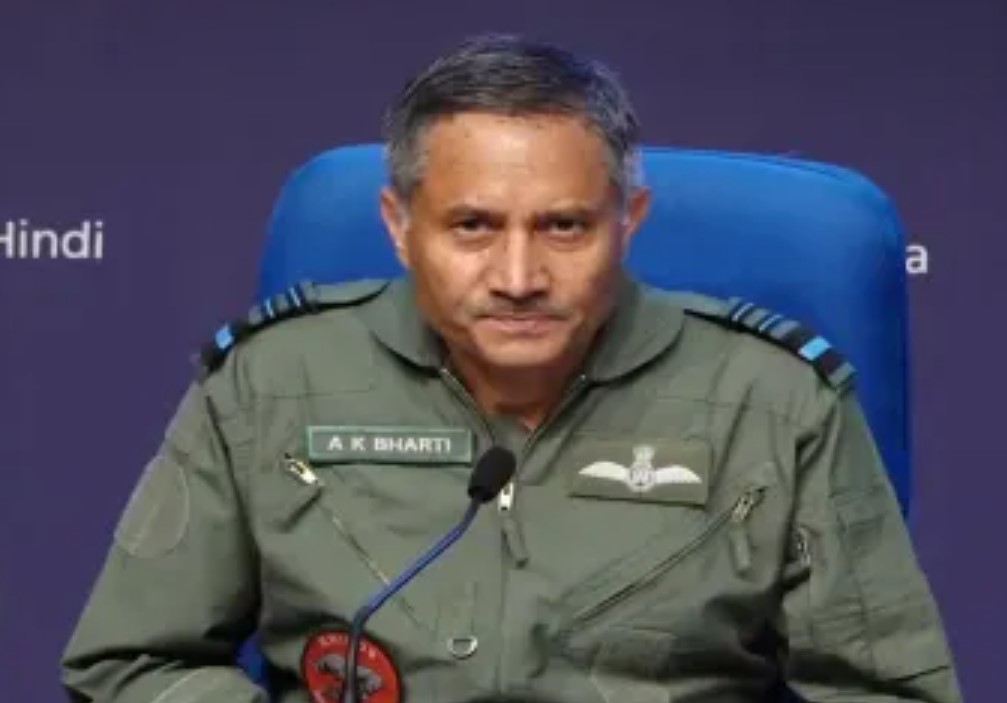
Air Marshal AK Bharti addressed a press briefing on Monday, providing details about Operation Sindoor. He explicitly stated that the operation’s objective was solely to target terrorists, emphasizing that the Indian Armed Forces were not engaged with the Pakistan Military or Pakistani civilians. “Our fight is with the terrorists, our fight is not with the Pakistan Military or Pakistan civilians, so that is very clear. We are very clear in our targeting,” he asserted.
Air Marshal Bharti underscored the effectiveness of the Indian Armed Forces, highlighting the precise strikes conducted during Operation Sindoor. He affirmed the strength of India’s defense capabilities, stating, “Our counter systems and trained air defence operators are fully capable, and our nation’s indigenous capability has proven its effectiveness. It has been demonstrated that no matter what kind of technology emerges, we are prepared to counter it. There is no need for excessive words, you have seen with your own eyes the consequences we have delivered.”
He also spoke about the evolving nature of modern warfare, predicting that future conflicts would significantly differ from past ones and stressing the importance for India to maintain a strategic advantage. “This was a different kind of warfare and is bound to happen. God forbid, but if we fight another war, that would be completely different from this one. It is a cat-and-mouse game, and we need to be ahead of the curve to beat the adversary,” he explained.
Responding to a query about strikes on Kirana Hills, Air Marshal AK Bharti stated, “Thank you for telling us that Kirana Hills houses some nuclear installation, we did not know about it. We have not hit Kirana Hills, whatever is there.”
Operation Sindoor was initiated by the Indian Armed Forces in the early hours of May 7, targeting nine terror sites located in Pakistan and Pakistan-occupied Jammu and Kashmir (PoK). This operation was a direct response to the terror attack in Pahalgam, Jammu and Kashmir, on April 22, which resulted in the deaths of 26 civilians, including a Nepali national.
On Saturday, Foreign Secretary Vikram Misri confirmed that the Director General of Military Operations from Pakistan contacted his Indian counterpart. Both sides agreed to a ceasefire, halting all military actions across land, sea, and air, effective from 5 pm. Mr. Misri indicated that instructions for enforcing the ceasefire had been issued, and another round of DGMO-level talks was scheduled for May 12 at noon.
However, shortly after the ceasefire agreement, reports emerged of Pakistan allegedly violating the cessation of hostilities. India’s air defense reportedly intercepted Pakistani drones amidst blackouts in Srinagar and Udhampur. Similar blackouts were also enforced in Pathankot and Ferozepur in Punjab, as well as Jaisalmer and Barmer in Rajasthan, with red streaks and explosions reported as India’s air defense intercepted drones in Udhampur.
During a special briefing, Foreign Secretary Vikram Misri stated that India viewed these alleged violations with “very serious note.” He called upon Pakistan to take appropriate measures to address these violations and handle the situation with seriousness and responsibility.