
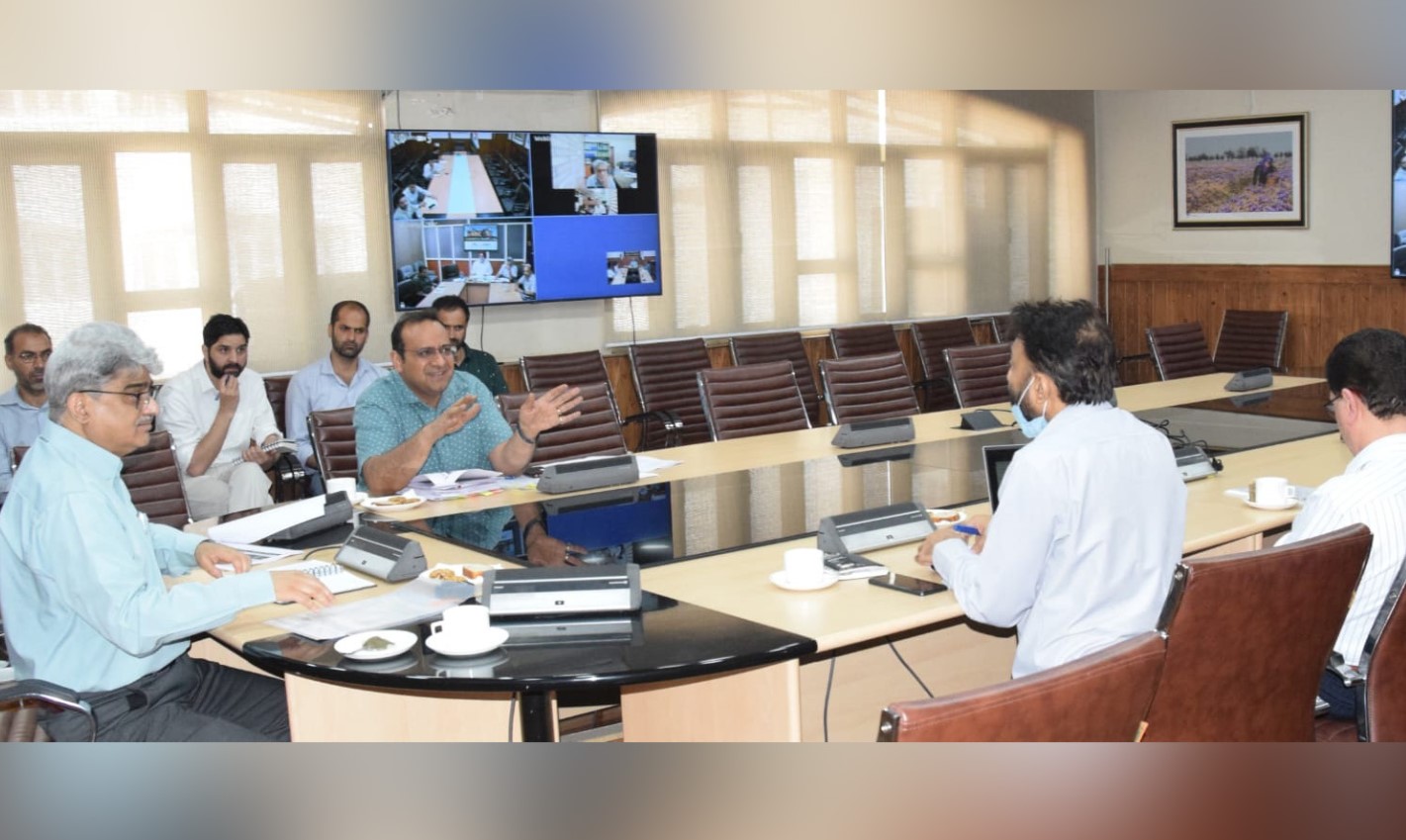
Chief Secretary Atal Dulloo recently chaired a meeting to review the Digital India Land Records Modernization Programme (DILRMP), urging the Revenue Department to expedite the massive digitization task. The meeting saw the participation of key officials including the Financial Commissioner, Revenue (FCR), Commissioner Secretary, IT, Secretary, Revenue, and Director, Land Records.
Dulloo assessed the progress across all components of the program, including the digitization of Jamabandis (records of rights), vectorization and digitization of cadastral maps, modernization of record rooms, scanning of historical records, and the updating of pending mutations. He stressed the importance of enhancing the capacity of additional staff and ensuring error-free data entry to achieve the program’s primary objective of providing an efficient and accurate land records system for citizens.
Financial Commissioner, Revenue, Shaleen Kabra, highlighted significant achievements, stating that most of the groundwork for the remaining modernization efforts had been completed. He projected that the program’s completion would enable real-time record updates and paperless registrations across the Union Territory.
Secretary Revenue, Kumar Rajeev Ranjan, informed the meeting that NIC-JK’s customized software for digital entry, mutation, and real-time Jamabandi updates has been successfully implemented. He cited successful pilot projects in Khairi Dadyal and Chak Wahab Din as proof-of-concept. To accelerate digitization, 100 Master Trainers are being deployed in each district, with 43 already trained.
Key initiatives discussed included the integration with the National Generic Document Registration System (NGDRS), public access to real-time auto-updated Records of Rights (RoR), and infrastructure support from JaKEGA for training and hosting.
To ensure spatial accuracy, a high-resolution mapping project is underway, and a Virtual Control Points Library is being developed for geospatial referencing. Significant progress has also been made in BISAG-facilitated map returns, mother map finalization, mobile app development for sub-parcel updates, and integration with satellite imagery, all targeted for completion within the next 12 months.
Since 2019, property registration has transitioned to a fully online model via NGDRS, supporting paperless deed creation through the “My Deed” editor, PAN verification, Digi Locker, and citizen feedback via the RAS platform. All 86 Sub-Registrar Offices are equipped with CCTV systems for transparency, and a Model Deed is being finalized for end-to-end digital operations.
While the digitization of legacy documents is ongoing and being uploaded to the LRIS portal, funding clearance is awaited for the physical infrastructure of 207 Modern Record Rooms (MRRs). These facilities, once completed, will provide compact storage, operational efficiency, and digital access systems in all tehsil headquarters.
Aadhaar linkage with land records is being implemented to streamline citizen verification, generating unique ULPINs for different land parcels. Prioritization will be given to land parcels already linked with Aadhaar through PM-KISAN data, with other beneficiaries to be enrolled during Farmer Registry camps.
Furthermore, all 881 Revenue Courts are now digitized and integrated into the JK Revenue Court Cases Monitoring System (JKRCCMS), allowing citizens to access case details, interim orders, and final decisions online at https://rccms.jk.gov.in. The final uploading of legacy cases is also in progress.
Atal Dulloo concluded by emphasizing the crucial role of digital integration, accurate geo-referencing, and citizen empowerment in land administration reforms. He called for continued inter-departmental coordination and institutional support to establish a transparent, accessible, and efficient land governance system, fostering overall development across various sectors in the UT.