
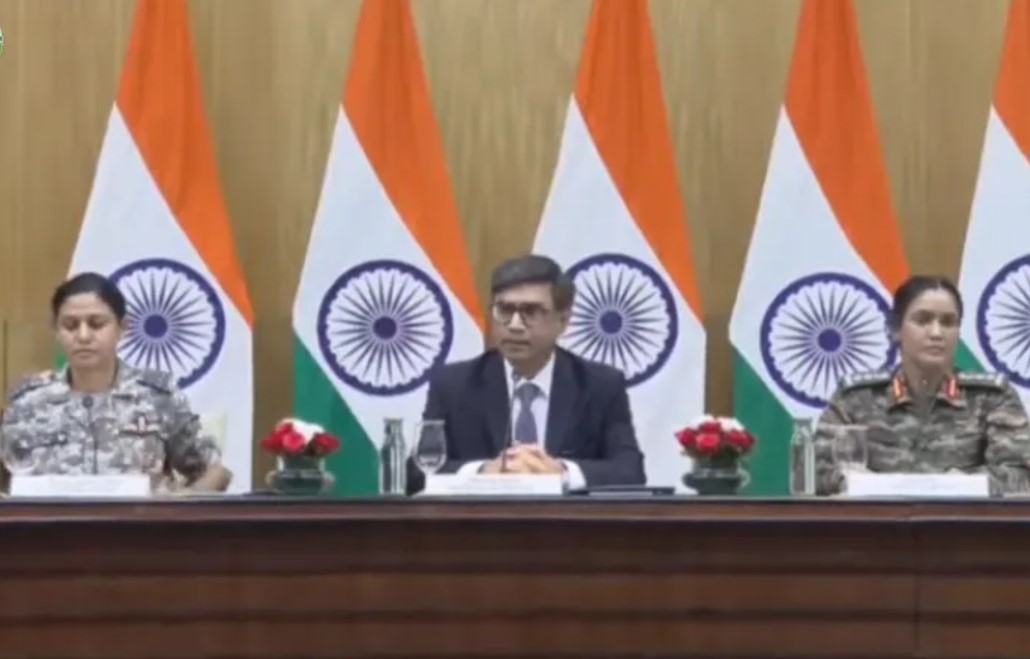
Foreign Secretary Vikram Misri stated on Thursday that the Pahalgam terror attack represented an “original escalation” by Pakistan, to which India responded in a “controlled, precise, measured, considered and non-escalatory” manner through precise strikes on terror infrastructure early on Wednesday.
During a joint press conference, Misri emphasized India’s intent to avoid further escalation, asserting that India was merely responding to Pakistan’s initial escalation. “Pakistan escalated on April 22, we are only responding to escalation. If further escalation, the response will be in the appropriate domain,” Misri said.
He highlighted Pakistan’s opposition at the UNSC to the role of TRF (The Resistance Front) despite the group claiming responsibility for the Pahalgam attack twice. Misri reiterated the statements made by Col Qureshi and Wing Commander Singh, who described India’s response as “non-escalatory, precise, and measured,” clarifying that “no military targets have been targeted; only terrorist infrastructure in Pakistan has been hit.”
Misri underscored Pakistan’s established reputation as a hub for global terrorism, citing instances such as the discovery of Osama Bin Laden and the presence of numerous UN-proscribed terrorists within its borders. He also noted recent admissions by Pakistan’s Defence Minister and former Foreign Minister regarding their country’s involvement with such terror groups. Furthermore, he found it “odd” that funerals of civilians were being conducted with coffins draped in the Pakistani national flag and with state honors.
Misri strongly condemned Pakistan’s targeting of civilians in Jammu and Kashmir through artillery fire. He specifically mentioned a “targeted attack on the Sikh community of J&K,” where a gurdwara in Poonch was hit, and Sikh community members came under attack, resulting in the deaths of three individuals. He stated that a total of 16 civilians had been killed and several others injured in Poonch due to these attacks.
The Defence Ministry, in a statement following the previous day’s press briefing on Operation Sindoor, reiterated that India’s response was “focused, measured and non-escalatory,” explicitly stating that Pakistani military establishments had not been targeted and warning that any attack on military targets in India would invite a suitable response.
The Ministry further detailed that on the night of May 7-8, Pakistan attempted to engage multiple military targets in Northern and Western India, including Awantipura, Srinagar, Jammu, Pathankot, Amritsar, Kapurthala, Jalandhar, Ludhiana, Adampur, Bhatinda, Chandigarh, Nal, Phalodi, Uttarlai, and Bhuj, using drones and missiles. These attempts were successfully neutralized by India’s Integrated Counter UAS Grid and Air Defence systems, with debris recovered from various locations serving as proof of the Pakistani attacks.
In response, on Thursday morning, Indian Armed Forces targeted Air Defence Radars and systems at several locations within Pakistan. The Indian response was described as being “in the same domain with same intensity as Pakistan.” The statement claimed that an Air Defence system in Lahore had been neutralized based on reliable intelligence.
The Defence Ministry also reported an increase in the intensity of unprovoked Pakistani firing across the Line of Control using mortars and heavy artillery in areas including Kupwara, Baramulla, Uri, Poonch, Mendhar, and Rajouri sectors of Jammu and Kashmir. This firing resulted in the loss of sixteen innocent lives, including three women and five children. India stated it was “compelled to respond” to halt the mortar and artillery fire from Pakistan.
Sources and related content