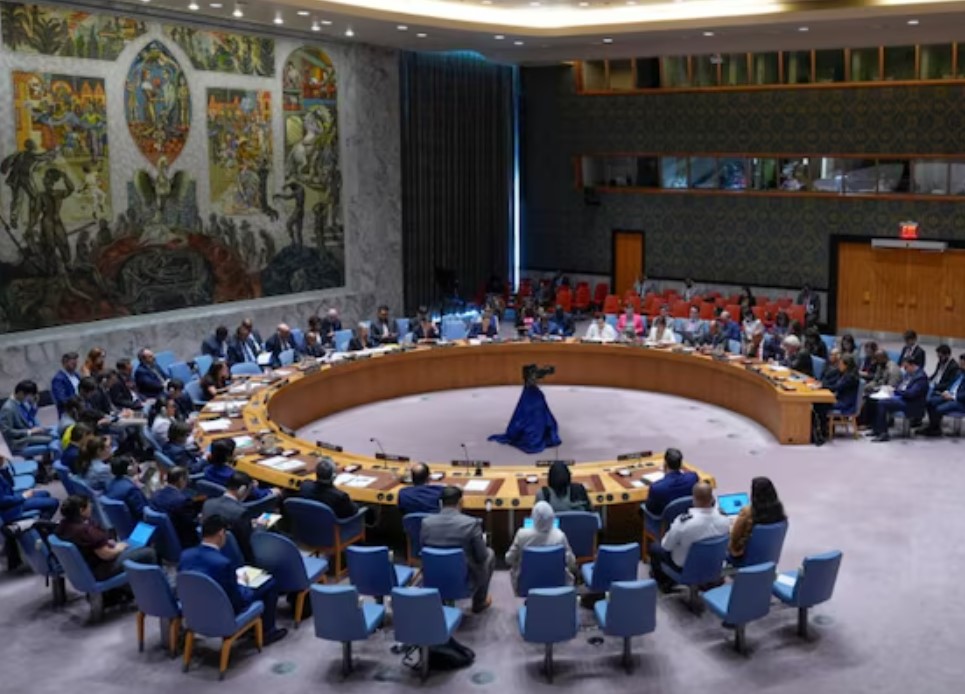
The United Nations Security Council convened closed-door consultations on Monday, at the request of Pakistan, a non-permanent member, to discuss the escalating tensions between India and Pakistan. Greece, holding the UNSC presidency for May, scheduled the meeting following a recent terrorist attack in Jammu and Kashmir’s Pahalgam that resulted in 26 fatalities and sparked outrage in India.
The approximately 90-minute discussion took place in a consultations room adjacent to the main UNSC Chamber. While the 15-member Council did not issue any formal statement afterward, Pakistan asserted that its objectives were “largely served.”
Khaled Mohamed Khiari, the Assistant Secretary-General for Middle East, Asia and the Pacific in the Departments of Political and Peacebuilding Affairs and Peace Operations, briefed the Council. Emerging from the meeting, Khiari conveyed a call for “dialogue and peaceful resolution of the conflict,” noting the “volatile” situation.
Ambassador Evangelos Sekeris, the Permanent Representative of Greece to the United Nations and the current UNSC President, characterized the session as a “productive meeting, helpful,” echoing his prior sentiment that such a meeting could offer an “opportunity to have views expressed and this might help to diffuse a bit tensions.” A Russian diplomat also expressed hope for “de-escalation” upon leaving the consultations.
Pakistan’s Permanent Representative to the United Nations, Ambassador Asim Iftikhar Ahmad, informed reporters that the country’s goals were “largely served and achieved” through the meeting. He outlined these objectives as facilitating a Council discussion on the deteriorating security environment and increasing tensions between India and Pakistan, and fostering an exchange of views on addressing the situation, including preventing confrontations with severe consequences and emphasizing the need for de-escalation.
Ambassador Ahmad expressed gratitude to the Council members for their engagement and their appeals for restraint, de-escalation, and dialogue. He affirmed Pakistan’s commitment to defending its sovereignty and territorial integrity while stating that the nation does not seek confrontation.
Pakistan also raised India’s alleged suspension of the Indus Waters Treaty of 1960, with Ambassador Ahmad asserting that “Water is life, not a weapon. These rivers sustain over 240 million Pakistanis.” He reiterated Pakistan’s “commitment to peaceful, cooperative relations with all our neighbours, including India,” and affirmed their openness to dialogue based on mutual respect and sovereign equality. Ambassador Ahmad concluded by emphasizing the pertinence of calls for dialogue, de-escalation, and peaceful dispute resolution, as voiced by the Secretary-General and Council members, given the “gravity of the situation.”
In contrast, India’s former Permanent Representative to the UN, Ambassador Syed Akbaruddin, had earlier told PTI that no “consequential outcome” was anticipated from a discussion initiated by a party seeking to shape perceptions through its Council membership, predicting that “India will parry such Pakistani efforts.” Following the meeting, he stated that “Pakistan’s grandstanding has flopped again today as in the past. As was expected there was no meaningful response by the Council. Indian diplomacy has yet again successfully parried Pakistani efforts to seek the Security Council’s intervention.”
Just hours before the UNSC consultations, UN Secretary-General Antonio Guterres expressed his concern over the heightened tensions between India and Pakistan, describing them as being at “their highest in years” and lamenting that “it pains me to see relations reaching a boiling point.” Speaking to the press, Guterres acknowledged the “raw feelings” following the “awful terror attack” in Pahalgam and reiterated his strong condemnation, emphasizing that “Targeting civilians is unacceptable – and those responsible must be brought to justice through credible and lawful means.”
The UN Chief stressed the critical need to avoid a military confrontation that could easily escalate, urging “maximum restraint and stepping back from the brink.” He stated that this has been his message in his ongoing communications with both countries, underscoring that “A military solution is no solution.”
The UN Security Council comprises five permanent members with veto power (China, France, Russia, UK, and the US) and ten non-permanent members: Algeria, Denmark, Greece, Guyana, Pakistan, Panama, South Korea, Sierra Leone, Slovenia, and Somalia.