
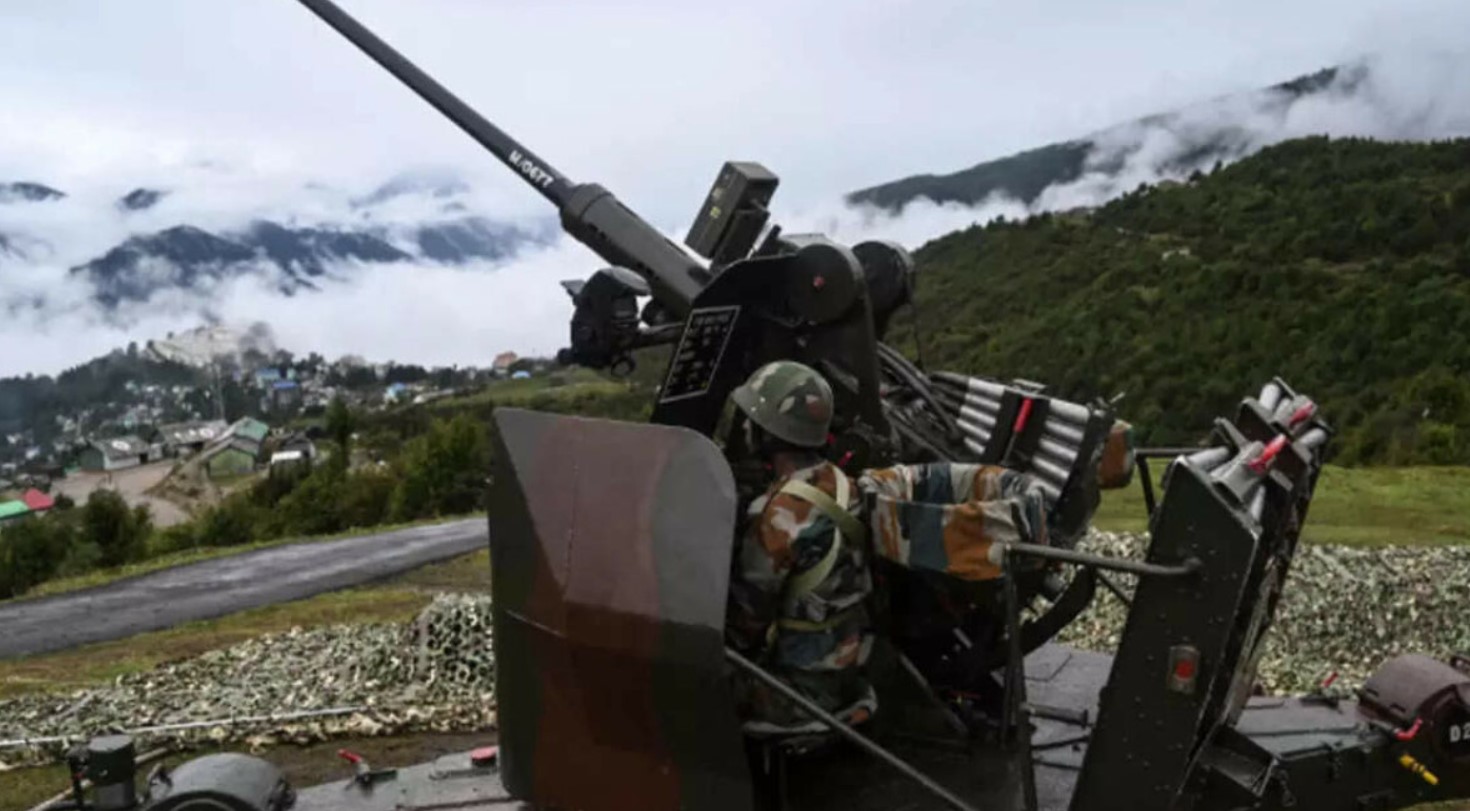
The Indian Army recently demonstrated its strengthening defense capabilities by effectively deploying the indigenous Akashteer system and upgraded L-70 Air Defence Guns. These systems proved instrumental in intercepting all missiles and drones during Pakistan’s significant aerial assault on May 9th and 10th.
An operator of the L-70 Air Defence Gun highlighted the system’s effectiveness, stating, “This gun system is very effective… We showed that we also have a system capable of destroying any target. It can track targets from a long distance and lock onto them. As soon as they enter the effective range, firing action is taken.” The soldier confidently reported a 100 percent success rate for the L-70 in neutralizing enemy drones during the conflict, adding, “We destroyed all the drones. Its success rate is 100 per cent.” The operator also expressed strong confidence in the Indian Army’s preparedness for future aerial threats, asserting, “Even in the future, if the enemy country tries to attack us by sending drones, aircraft, or missiles, we will give them a befitting reply, and we have the capability to destroy them in the air itself…”
Adding to this defensive shield is Akashteer, India’s fully domestically developed, automated Air Defence Control and Reporting System. This system moved beyond theoretical discussions by successfully intercepting and neutralizing every incoming projectile during the India-Pakistan hostilities. According to an official statement, “In the dark skies, a new kind of warrior awakened. It did not roar like a fighter jet or flash like a missile. It listened. It calculated. It struck. This invisible shield, Akashteer, is no longer a concept confined to defence journals. It is the sharp edge of India’s air defence, the unseen wall that stopped a barrage of missiles and drones on the night of May 9th and 10th, when Pakistan launched its deadliest attack on Indian military and civilian areas. Akashteer is India’s fully indigenous, automated Air Defence Control and Reporting System, which intercepted and neutralised every inbound projectile.”
The statement further emphasized the contrast in defense capabilities, noting, “What stood between them and their intended targets was not just technology, but years of commitment to Atmanirbhar Bharat. While Pakistan relied on imported HQ-9 and HQ-16 systems that failed to detect and intercept Indian strikes, Akashteer showcased India’s dominance in real-time, automated air defence warfare,” during Pakistan’s retaliatory actions following Operation Sindoor.
Akashteer’s capabilities demonstrate its speed and efficiency in threat engagement. The system’s integrated components minimize the risk of friendly fire, enabling swift engagement of hostile targets while safeguarding friendly aircraft within contested airspace. The suite of integrated sensors includes the Tactical Control Radar REPORTER, 3D Tactical Control Radars, Low-Level Lightweight Radar, and the radar of the Akash Weapon System.
The official statement described Akashteer’s operational philosophy: “Akashteer is not about brute force. It is about intelligent warfare. The system provides a common, real-time air picture to all involved parties (control room, radars and Defence Gun), enabling coordinated air defence operations. It is a system designed to automate detection, tracking and engagement of enemy aircraft, drones and missiles. It integrates various radar systems, sensors and communication technologies into a single operational framework.”
Akashteer’s functionality involves gathering and processing data from multiple sources, allowing for automated, real-time engagement decisions. As an integral part of the broader C4ISR (Command, Control, Communications, Computers, Intelligence, Surveillance and Reconnaissance) framework, it operates in synergy with other defense systems. Its vehicle-based design enhances its mobility and operational ease in hostile environments.
This deployment of Akashteer signifies a strategic evolution for India, moving from a primarily passive defense posture to one of proactive retaliation. Its seamless integration within India’s larger C4ISR ecosystem enables the Army, Navy, and Air Force to achieve unprecedented operational synergy.