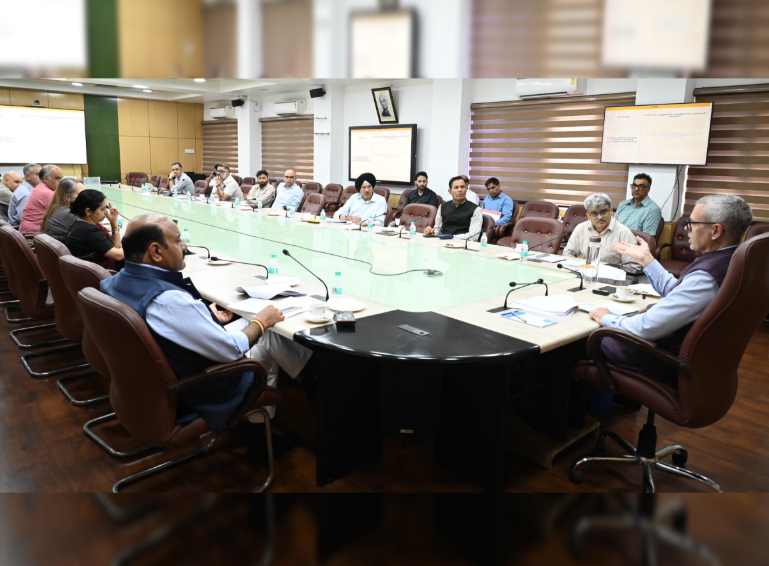
Jammu and Kashmir Chief Minister Omar Abdullah affirmed his government’s dedication to creating a more business-friendly environment by streamlining regulations across the Union Territory. During a high-level meeting, he reviewed progress on initiatives aimed at simplifying business operations, a key part of a national effort led by the Union Cabinet Secretariat, PMO, NITI Aayog, DPIIT, and MSME.
The focus of these reforms is on eliminating unnecessary regulations, reducing compliance burdens, particularly for Micro, Small, and Medium Enterprises (MSMEs), promoting digitalization and single-window clearances, and decriminalizing business laws where feasible. Abdullah instructed officials to break down action plans with five to six-month timelines into smaller, more manageable fortnightly deliverables, emphasizing the need for close progress tracking and prompt resolution of delays. He mandated the immediate uploading of finalized action plans to the Management Information System (MIS) portal and swift implementation.
To ensure accountability, a bi-monthly review mechanism was established to assess reform progress. Abdullah reiterated his government’s commitment to fostering a conducive business environment.
Commissioner Secretary Industries and Commerce, Vikramjit Singh, detailed the J&K State Task Force’s work, which identified 23 priority areas including land use, labor reforms, building regulations, utility permissions, and governance. Action plans with clear timelines were developed in collaboration with relevant departments.
Key discussion points included:
Implementing flexible zoning for mixed-use development.
Simplifying and digitizing land use change processes.
Streamlining fire service clearances and road width norms for rural industries.
Updating building bylaws to minimize land loss.
GIS mapping of industrial estates and integration with the India Industrial Land Bank (IILB).
Enabling night-time employment for women and raising worker thresholds.
Decriminalizing minor violations and simplifying licensing procedures.
Integrating water and electricity services into the single-window system.
Fully linking J&K’s Single Window Portal with the National Single Window System (NSWS).
Abdullah stressed a proactive approach, emphasizing the importance of uploading approved action plans and ensuring continuous monitoring and periodic reviews for effective reform implementation.