
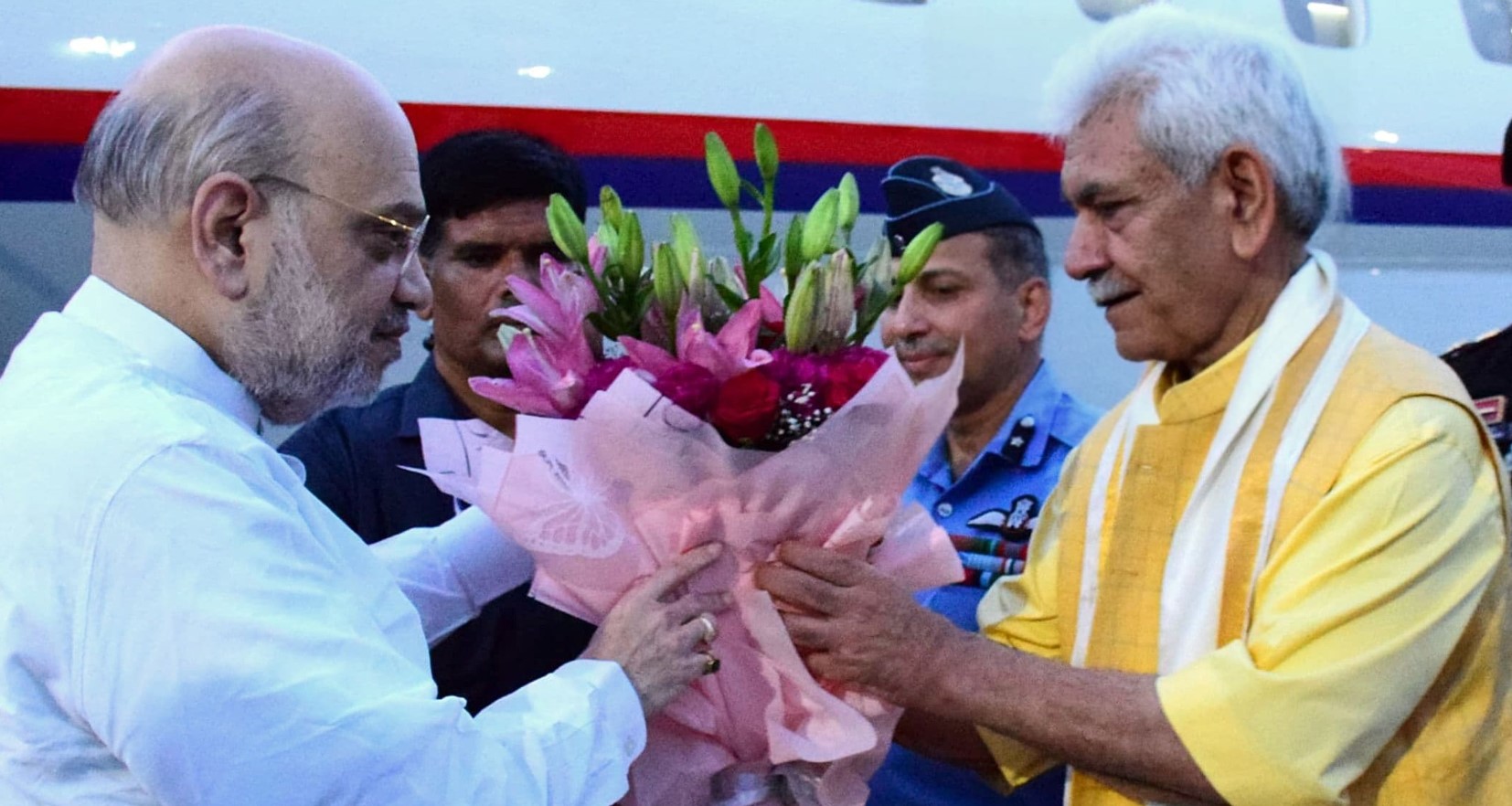
Union Home Minister Amit Shah arrived in Jammu on Friday evening for a two-day visit to assess the security situation in Jammu and Kashmir and engage with residents affected by shelling in Poonch. This marks Shah’s initial visit to the Union Territory following “Operation Sindoor.”
Upon his arrival, Shah was greeted at the airport by Lieutenant Governor Manoj Sinha before heading to the Raj Bhawan. He is scheduled to chair a high-level security review meeting at the Raj Bhawan later tonight. The meeting, expected to last one and a half hours, will include the Lieutenant Governor and senior officials from the army, paramilitary forces, police, intelligence agencies, and civil administration. Discussions will cover the security situation, ongoing anti-terrorist operations, and security and administrative preparations for the Amarnath Yatra, which commences on July 3.
During his stay in the Jammu region, Shah also plans to visit religious sites, meet with individuals impacted by shelling, and interact with BSF personnel in Poonch. This district experienced the highest number of civilian fatalities, with 14 out of 28 lives lost due to indiscriminate Pakistani shelling and drone attacks between May 7 and 10.
On Saturday, Shah will travel to Poonch to interact with shelling-affected families and visit damaged religious sites, including the Singh Sabha Gurdwara. He will also hold a meeting with officials to evaluate the damage in the severely impacted district. Furthermore, the minister will visit the Border Security Force (BSF) camp in Poonch to meet with jawans. He is slated to address civilians affected by Pakistani shelling at Dak Bungalow in Poonch and BSF soldiers at their Unit Headquarters in Khanetar. Shah is also expected to distribute appointment letters to the next of kin of civilians killed in the shelling.
This visit is Shah’s third to Jammu and Kashmir since April 6 and his first since the Indian armed forces conducted strikes on terror infrastructure in Pakistan and Pakistan-occupied Kashmir (PoK) on May 7. These strikes were in retaliation for the Pahalgam terror attack, which resulted in the deaths of 26 people, primarily tourists.